1

Country: USA | Funding: $579M
Varda is a space manufacturing startup that focuses on creating products and drugs in space for terrestrial applications. It is building a fleet of uncrewed space capsules that can function as orbital laboratories or manufacturing platforms for products whose development in space yields better efficiencies or purities than in the gravity of Earth. The company since 2023 has deployed six missions to orbit with its gumdrop-shaped free-flying W-Series capsule, with all but its fourth mission successfully re-entering from space. It plans to debut a next-generation capsule in 2030.
Varda is a space manufacturing startup that focuses on creating products and drugs in space for terrestrial applications. It is building a fleet of uncrewed space capsules that can function as orbital laboratories or manufacturing platforms for products whose development in space yields better efficiencies or purities than in the gravity of Earth. The company since 2023 has deployed six missions to orbit with its gumdrop-shaped free-flying W-Series capsule, with all but its fourth mission successfully re-entering from space. It plans to debut a next-generation capsule in 2030.
2

Country: USA | Funding: $1.6B
United Launch Alliance manufactures and operates spacecraft that are capable of Earth orbit and deep space exploration.
United Launch Alliance manufactures and operates spacecraft that are capable of Earth orbit and deep space exploration.
3

Country: Germany | Funding: $927.1M
Isar Aerospace is a rocket startup that provides access to space for small and medium satellites, enabling global satellite constellations. Isar launched the first commercial rocket to reach orbit from continental Europe. The startup is now focused on scaling up operations to meet rising demand, with a long-term goal of conducting about 40 launches a year.
Isar Aerospace is a rocket startup that provides access to space for small and medium satellites, enabling global satellite constellations. Isar launched the first commercial rocket to reach orbit from continental Europe. The startup is now focused on scaling up operations to meet rising demand, with a long-term goal of conducting about 40 launches a year.
4

Country: China | Funding: CN¥5.1B
Galactic Energy Aerospace Technology is a private aerospace company that engages in the low-cost commercial space launch business.
Galactic Energy Aerospace Technology is a private aerospace company that engages in the low-cost commercial space launch business.
5
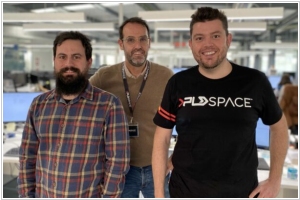
Country: Spain | Funding: €440.6M
PLD Space provides suborbital and orbital commercial launch services to payloads and nanosatellites. It debuted with the launch of the Miura 1 rocket in 2023 and has been developing a series of rockets, including the Miura 5, which lands in the ocean before being recovered for reuse; the Miura Next, a medium-lift rocket with propulsive landing capabilities; and both heavy and super-heavy versions of the Miura Next, which feature three and five boosters, respectively. The company aims to launch more than 30 times per year by 2030.
PLD Space provides suborbital and orbital commercial launch services to payloads and nanosatellites. It debuted with the launch of the Miura 1 rocket in 2023 and has been developing a series of rockets, including the Miura 5, which lands in the ocean before being recovered for reuse; the Miura Next, a medium-lift rocket with propulsive landing capabilities; and both heavy and super-heavy versions of the Miura Next, which feature three and five boosters, respectively. The company aims to launch more than 30 times per year by 2030.
6

Country: Australia | Funding: $332.6M
Gilmour Space Technologies is a space rocket company that develops low-cost hybrid launch vehicles.
Gilmour Space Technologies is a space rocket company that develops low-cost hybrid launch vehicles.
7

Country: Germany | Funding: $117M
HyImpulse is developing a three-stage launch vehicle with hybrid rocket engines for launching small satellites (up to 600 kg) into low-Earth orbit. It uses paraffin fuel, which is much cheaper, safer in operation, more efficient and has a lower environmental impact than kerosene fuel. The engines themselves combine the features of a liquid propulsion system (throttling, shutting down and restarting) with economic and operational efficiency of a solid-fuel propulsion system. A thoughtful selection of materials also makes the engine itself less expensive, making launching satellites into space affordable even for small companies. For now the company prepares the launch of a sounding rocket that carries 250 kg to 200 km altitude to demonstrate the tech.
HyImpulse is developing a three-stage launch vehicle with hybrid rocket engines for launching small satellites (up to 600 kg) into low-Earth orbit. It uses paraffin fuel, which is much cheaper, safer in operation, more efficient and has a lower environmental impact than kerosene fuel. The engines themselves combine the features of a liquid propulsion system (throttling, shutting down and restarting) with economic and operational efficiency of a solid-fuel propulsion system. A thoughtful selection of materials also makes the engine itself less expensive, making launching satellites into space affordable even for small companies. For now the company prepares the launch of a sounding rocket that carries 250 kg to 200 km altitude to demonstrate the tech.
8

Country: Japan | Funding: ¥4.2B
SPACE ONE is a launch services provider that uses small rockets. We will offer the world’s shortest lead time from contractual engagement to launch, as well as the world’s most frequent launching schedule.
SPACE ONE is a launch services provider that uses small rockets. We will offer the world’s shortest lead time from contractual engagement to launch, as well as the world’s most frequent launching schedule.
9

Country: Canada | Funding: CA$14.5M
Canada Rocket Company plans to become the first Canadian company to have the capacity to launch medium-payload satellites in space, filling in a potentially important niche in Canada’s defence. The company is targeting the “the missing middle” portion of the market - its rockets will deliver medium payloads, weighing up to 6,500 kilograms
Canada Rocket Company plans to become the first Canadian company to have the capacity to launch medium-payload satellites in space, filling in a potentially important niche in Canada’s defence. The company is targeting the “the missing middle” portion of the market - its rockets will deliver medium payloads, weighing up to 6,500 kilograms
10

Country: USA | Funding: $8.6M
bluShift is a small space launch service that powers it rockets using a CO2-neutral biofuel
bluShift is a small space launch service that powers it rockets using a CO2-neutral biofuel